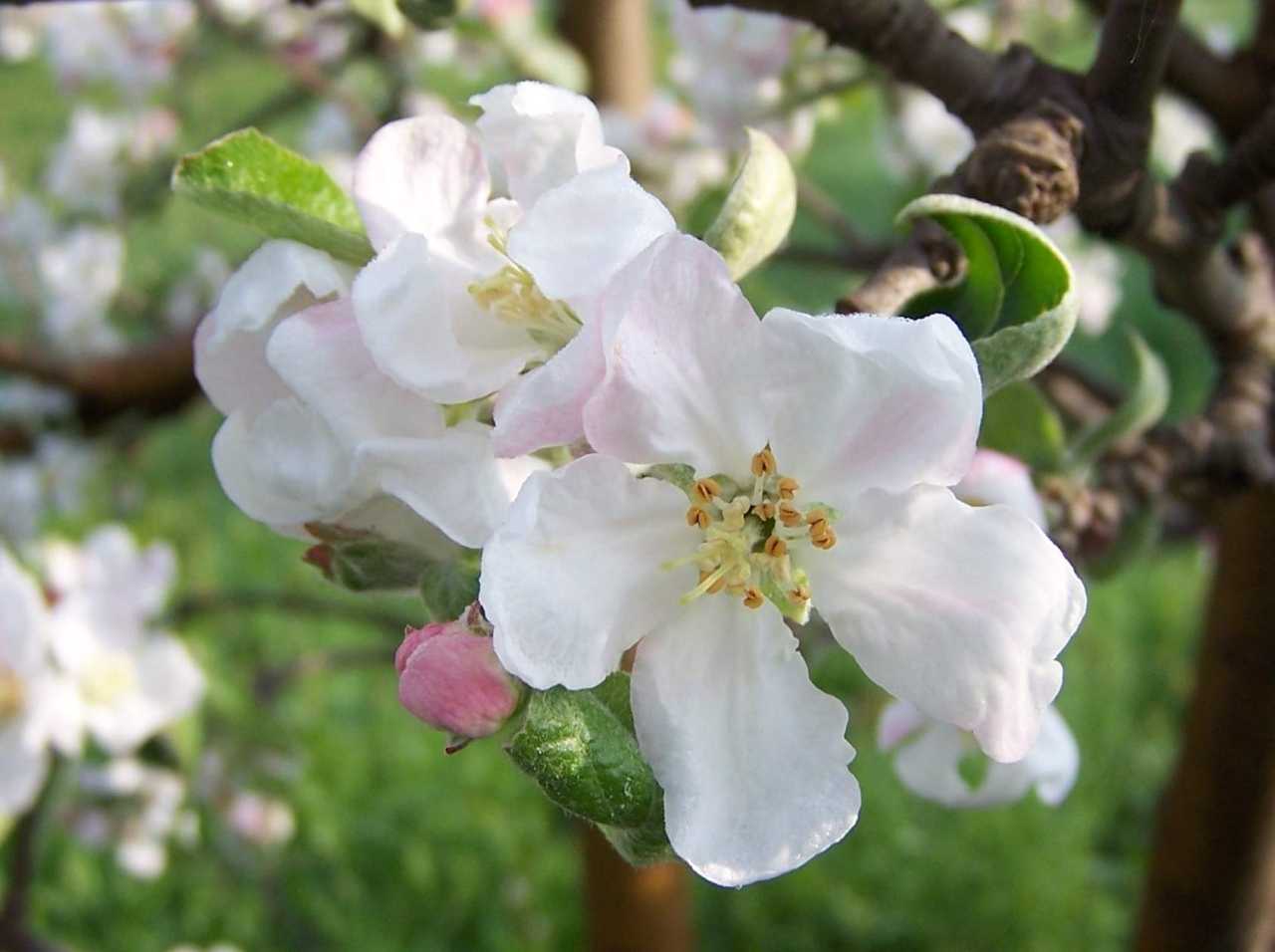
Pear trees are the second most common fruit tree in Polish home orchards after apples, but they receive considerably less attention in popular gardening literature. In practice, pears present a distinct set of requirements — they are less tolerant of frost during flowering than apples, more demanding in terms of soil drainage, and require at least two compatible varieties for adequate pollination. In small garden plots, these constraints mean that variety selection and site positioning are the most consequential early decisions a grower makes.
Site Requirements
Pears flower earlier than apples — in Poland, blooming typically begins between 10 and 20 April, depending on region and year. This places flowers at higher risk from late frost events, which in the Mazovian lowlands occasionally occur into early May. A south-facing slope or a position close to a masonry wall that absorbs daytime heat and releases it at night provides meaningful frost protection for early-blooming varieties. Avoid frost pockets — low-lying areas where cold air settles on still nights — even in gardens that generally seem warm and sheltered.
In terms of soil, pears are more sensitive to poor drainage than apples. Roots sitting in waterlogged soil for more than 48 hours during the growing season suffer oxygen deprivation that manifests as leaf yellowing and dieback the following spring, often mistaken for disease. If the garden soil has a clay content above 40%, raised bed planting or installation of a simple perforated drainage pipe below the planting site is worth the effort.
Variety Selection and Cross-Pollination
All common European pear varieties (Pyrus communis) require cross-pollination from a different, compatible variety to produce a reliable crop. Unlike apples, where a range of commercial varieties overlap in flowering time, pear varieties divide more clearly into early, mid-season, and late groups. Two varieties planted together must overlap in bloom timing for pollination to occur. The following four varieties cover the main options suited to Polish growing conditions:
- Konferencja (Conference) — the most widely grown pear in Poland. Mid-season bloom. Elongated fruit with pale green skin that develops a slight bronze blush when fully ripe. Harvest in September. Stores until November under cool conditions. This variety is partially self-fertile but produces significantly better crops with a companion. Pair with Faworytka or Bonkreta Williamsa.
- Faworytka — bred at the Research Institute of Horticulture in Skierniewice. Late summer ripening (August). Medium-sized golden-yellow fruit. Good frost resistance. An effective pollinator for Conference and Bonkreta. Does not store well — best consumed fresh within two weeks of picking.
- Bonkreta Williamsa (Williams Bon Chrétien) — early to mid bloom. One of the most aromatic European pears, with a distinctive musky fragrance when ripe. Harvest in late August. Susceptible to fire blight, which is a notable downside in regions where this disease is present. Pair with Konferencja or Lukasówka.
- Lukasówka — a Polish variety with late harvest (October). Large, juicy fruit. Good storage duration into December. Late-blooming, so it escapes many frost events. Useful as a pollinator for Conference when planted at the same time.
In small gardens with space for only one pear tree, plant Konferencja (Conference) — it produces partial crops without a pollinator and is available on compact Quince C rootstock, which limits tree height to 2.5–3 m.
Rootstock Options for Limited Spaces
Pear trees are grafted onto either pear or quince rootstocks. Quince rootstocks (particularly Quince A and Quince C) produce smaller, earlier-bearing trees that are better suited to home gardens. Quince C is the most dwarfing option currently available in Polish nurseries, producing trees of 2.5–3 m after ten years. Quince A reaches 3.5–4 m. Both require staking for the first four to five years of the tree's life, as root systems are less extensive than those on seedling pear rootstocks.
One compatibility note: not all pear varieties graft directly onto quince rootstock without forming a weak union. Bonkreta Williamsa in particular often requires an interstock (a short section of compatible variety grafted between rootstock and scion). When purchasing from a Polish nursery, ask whether the tree on quince rootstock is direct-grafted or uses an interstock — nurseries in the Grójec district, which is the primary apple and pear growing region of Poland, typically label this clearly.
Pruning Pear Trees
Pear trees on quince rootstock are pruned using a central leader or slender spindle system, similar to intensive apple cultivation. The main difference in approach is that pears produce spurs (short fruiting branchlets) more readily than apples, and these spurs remain productive for eight to twelve years before becoming exhausted. Annual pruning should therefore focus on thinning out old, congested spur clusters rather than removing large branches, unless corrective structural work is needed.
Summer pruning — shortening this year's lateral shoots to five to seven leaves in late July — is a standard technique in pear cultivation that promotes spur development and limits tree vigour on dwarfing rootstocks. Research from Wageningen University confirms that summer pruning of pear trees on Quince C rootstock improves fruit colour development and reduces the following year's pruning workload compared to winter-only pruning regimes. See the Wageningen Plant Research Institute for published trial data on this technique.
Identifying Harvest Maturity
Unlike apples, pears should generally not be left on the tree until fully ripe. Most European pear varieties ripen from the inside out — by the time the skin shows softness near the stem, the core may already be breaking down. The correct approach is to harvest pears when they reach physiological maturity (measured by starch-iodine tests or firmness readings), then ripen them at room temperature. A practical home test: hold the pear horizontal by its spur and apply gentle upward pressure near the stem end. If the fruit separates cleanly, it is ready to pick.
Konferencja picked in early September ripens to eating condition at room temperature in five to seven days. Once soft at the stem, move to cold storage to extend shelf life by another one to two weeks. Lukasówka harvested in October may need two to three weeks of after-ripening at 15–18°C before it develops its full flavour — placing it in cold storage immediately after picking stops this process and results in hard, starchy fruit.
Common Problems in Polish Home Orchards
Fire blight (Erwinia amylovora) is the most destructive bacterial disease affecting pear trees in Poland. The pathogen enters through open flowers during warm, wet conditions at bloom time. Infected shoots display the characteristic shepherd's crook wilting, and bark at the base of affected shoots develops a water-soaked, reddish-brown discolouration when cut. Affected wood must be removed by cutting 30–40 cm below the visible infection margin, with tools disinfected between cuts using 70% alcohol or a 10% bleach solution. Burn or bag all removed material.
Pear leaf blister mite (Eriophyes pyri) causes small pinkish-green blisters on leaves in spring that turn brown by summer. Heavy infestations reduce photosynthetic area and weaken young trees. Lime-sulfur applied at bud swell in early spring before leaf emergence is the standard control measure in home orchards. On established trees with moderate infestations, the damage is primarily cosmetic and does not significantly affect fruit yield.